Argentina in 102 languages: Buenos Aires, ISO codes and 23 provinces
Argentina is officially the República Argentina, the Argentine Republic, and carries the ISO codes AR, ARG and 032. Below: the name in 102 languages, Buenos Aires in 25, and the 23 provinces plus the autonomous capital with their ISO 3166-2 codes.
Official languagesSpanish (de facto)
Checked
- alpha-2
- AR
- alpha-3
- ARG
- numeric
- 032
República Argentina
- English
- ArgentinaArgentine Republic
- Capital
- Buenos AiresBuenos Aires
ISO 3166-1, checked 28 October 2026
Argentina in other languages
| Languages | ISO 639-2 | Name | Romanised |
|---|---|---|---|
| English, Catalan, Czech, Corsican, Danish, Basque, Faroese, Scottish Gaelic, Hausa, Croatian, Indonesian, Italian, Kinyarwanda, Latin, Lithuanian, Malay, Norwegian, Portuguese, Romanian, Kirundi, Slovenian, Sami, Spanish, Swedish, Tok Pisin, Turkmen, Uzbek | eng / cat / ces / cos / dan / eus / fao / gla / hau / hrv / ind / ita / kin / lat / lit / msa / nor / por / ron / run / slv / smi / spa / swe / tpi / tuk / uzb | Argentina | same as written |
| Afrikaans, West Frisian, Dutch | afr / fry / nld | Argentinië | same as written |
| Hungarian, Icelandic, Slovak | hun / isl / slk | Argentína | same as written |
| German, Luxembourgish | deu / ltz | Argentinien | same as written |
| Estonian, Finnish | est / fin | Argentiina | same as written |
| Azerbaijani | aze | Arqentina, Argentina | same as written |
| Bambara | bam | Arazantini | same as written |
| Breton | bre | Arc'hantina | same as written |
| Welsh | cym | yr Ariannin | same as written |
| Esperanto | epo | Argentino | same as written |
| French | fra | Argentine | same as written |
| West Frisian | fry | Argentynje | same as written |
| Irish | gle | an Airgintín | same as written |
| Galician | glg | Arxentina | same as written |
| Igbo | ibo | Ajentina, Ajentain | same as written |
| Kurdish | kur | Arjantîn | same as written |
| Latvian | lav | Argentīna | same as written |
| Malagasy | mlg | Arzantina | same as written |
| Maltese | mlt | Arġentina | same as written |
| Polish | pol | Argentyna | same as written |
| Quechua | que | Arjintina | same as written |
| Romansh | roh | Argentinia | same as written |
| Samoan | smo | Atenitina | same as written |
| Albanian | sqi | Argjentinë | same as written |
| Swahili | swa | Ajentina | same as written |
| Tagalog | tgl | Arhentina | same as written |
| Tongan | ton | 'Asenitina | same as written |
| Turkish | tur | Arjantin | same as written |
| Vietnamese | vie | Ác-hen-ti-na | same as written |
| Walloon | wln | Årdjintene | same as written |
| Abaza, Altai, Bashkir, Chechen, Karakalpak, Kazakh, Kyrgyz, Khakas, Komi, Karachay-Balkar, Kumyk, Macedonian, Russian, Serbian, Tajik | abq / alt / bak / che / kaa / kaz / kir / kjh / kom / krc / kum / mkd / rus / srp / tgk | Аргентина | Argentina |
| Belarusian | bel | Аргентына, Аргенціна | Arhentyna, Arhencina |
| Bulgarian | bul | Аржентина | Aržentina |
| Chuvash | chv | Аргентинӑ | Argentină |
| Kabardian | kbd | Аргентинэ | Argentină |
| Mongolian | mon | Аргентин | Argentin |
| Ossetian | oss | Аргентинӕ | Argentinä |
| Ukrainian | ukr | Аргентина | Arhentyna |
| Arabic | ara | الارجنتين / الأرجنتين | al-Arǧantīn |
| Persian | fas | آرژانتین | Āržāntīn |
| Pashto | pus | ارجنتاين | Arǧantāyn |
| Uyghur | uig | ئارگېنتىنا | Argentina |
| Urdu | urd | ارجنٹینا, ارجینٹینا, ارجنٹائن | Arǧanṫīnā, Arǧenṫīnā, Arǧanṫā'in |
| Dhivehi | div | އާރްޖެންޓީނާ | Ārjentīnā |
| Amharic | amh | አርጀንቲና, አርጀንቲን | Arǧantinā, Arǧantin |
| Hebrew | heb | ארגנטינה | Argenṭīna |
| Yiddish | yid | אַרגענטינע | Argentine |
| Greek | ell | Αργεντινή | Argentinḗ |
| Armenian | hye | Արգենտինա | Argentina |
| Georgian | kat | არგენტინა | Argentina |
| Hindi | hin | अर्जेंटीना, अर्जेंटाइन | Arjẽṭīnā, Arjẽṭāin |
| Bengali | ben | আর্জেণ্টাইনা | Ārjeṇṭāinā |
| Tamil | tam | ஆர்ஜென்டீனா | Ārjeṉtīṉā |
| Chinese | zho | 阿根廷 | Agenting |
| Japanese | jpn | アルゼンティン, アルゼンチン | Aruzentin, Aruzenchin |
| Korean | kor | 아르헨티나 | Areuhentina |
| Burmese | mya | အာဂျင်တီးနား | Ajĩtìnà |
| Thai | tha | อาร์เจนติน่า | Ārchentinā |
Twenty-seven languages write the name exactly as Spanish does. West Frisian has two spellings, Argentinië and Argentynje. Russian and fourteen other languages in Cyrillic share one spelling, which Ukrainian writes the same way but reads Arhentyna.
The land of silver
Argentina comes from Latin argentum, silver. Explorers of the Río de la Plata basin in the early sixteenth century heard of silver in the interior, and the word Argentina appears on a Venetian map as early as 1536. Spanish itself would say plata, as in the river's name; the Latin-derived form was probably brought by Venetian and Genoese navigators.
The first written use in Spanish is the title of La Argentina, a poem of 1602 by Martín del Barco Centenera. The state was the Viceroyalty of the Río de la Plata under Spain and the United Provinces of the Río de la Plata after independence. The constitution of 1826 was the first to use Argentine Republic, the constitution of 1853 formalised Argentine Confederation, and a decree of 1860 settled on Argentine Republic, declaring every name used since 1810 valid.
English long called the country the Argentine, from the adjective. In the table, most European languages keep the -ina ending and only adapt the spelling to their alphabet: Arġentina in Maltese, Argjentinë in Albanian, Arxentina in Galician. Slavic and East Asian forms follow how the g sounds: Russian Аргентина keeps a hard g, Ukrainian and Belarusian read it as h, Bulgarian Аржентина and Persian آرژانتین (Āržāntīn) have zh, and Korean 아르헨티나 (Areuhentina) has an h.
Buenos Aires in other languages
| Languages | ISO 639-2 | Name | Romanised |
|---|---|---|---|
| English, German, French, Spanish | eng / deu / fra / spa | Buenos Aires | same as written |
| Esperanto | epo | Buenos-Ajreso | same as written |
| Latvian | lav | Buenosairesa | same as written |
| Lithuanian | lit | Buenos Airės | same as written |
| Tagalog | tgl | Buenos Áires | same as written |
| Bulgarian | bul | Буенос Айрес | Buenos Ajres |
| Russian | rus | Буэнос-Айрес | Buènos-Ajres |
| Ukrainian | ukr | Буенос-Айрес | Buenos-Ajres |
| Arabic | ara | بوينس ايرس / بوينس أيرس, بوينس آيرس | Buwīnus Ayris, Buwīnus Āyris |
| Persian | fas | بوئنوس آیرس | Bū'enos Āyres |
| Pashto | pus | بوېنوس ايرېس | Būenos Ayres |
| Uyghur | uig | بۇئېنوس ئايرېس | Bu'enos Ayres |
| Amharic | amh | ቡዌነስ አይሬስ | Buwenas Ayres |
| Greek | ell | Μπουένος Άιρες | Mpouénos Áires |
| Georgian | kat | ბუენოს-აირესი | Buenos-Airesi |
| Hindi | hin | ब्यूनस आयर्स | Byūnas Āyars |
| Bengali | ben | বোয়েনোস আইরেস | Boyenos Āires |
| Tamil | tam | போனஸ் அயர்ஸ் | Pōṉas Ayars |
| Chinese | zho | 布宜諾斯艾利斯 / 布宜诺斯艾利斯 | Buyinuosi Ailisi |
| Japanese | jpn | ブエノス・アイレス | Buenosu Airesu |
| Korean | kor | 부에노스아이레스 | Buenoseu Aireseu |
| Thai | tha | บูเอโนสไอเรส | not given |
Arabic writes the second word with and without hamza and with a long ā. No romanisation is given for the Thai form.
The 23 provinces of Argentina and the autonomous city
Argentina has 23 provinces (provincias) and one autonomous city, Buenos Aires, the federal capital. Each province has its own constitution. ISO 3166-2:AR codes each unit with a single letter, and the letters do not follow the alphabet: Salta is AR-A, Buenos Aires Province AR-B, Córdoba AR-X.
| ISO 3166-2 | Spanish | English | Administrative centre | Change |
|---|---|---|---|---|
| Provinces provincias23 | ||||
| AR-B | Buenos Aires | Buenos Aires Province | La PlataLa Plata | |
| AR-K | Catamarca | Catamarca | San Fernando del Valle de CatamarcaSan Fernando del Valle de Catamarca | |
| AR-H | Chaco | Chaco | ResistenciaResistencia | |
| AR-U | Chubut | Chubut | RawsonRawson | |
| AR-X | Córdoba | Córdoba | CórdobaCórdoba | |
| AR-W | Corrientes | Corrientes | CorrientesCorrientes | |
| AR-E | Entre Ríos | Entre Ríos | ParanáParaná | |
| AR-P | Formosa | Formosa | FormosaFormosa | |
| AR-Y | Jujuy | Jujuy | San Salvador de JujuySan Salvador de Jujuy | |
| AR-L | La Pampa | La Pampa | Santa RosaSanta Rosa | |
| AR-F | La Rioja | La Rioja | La RiojaLa Rioja | |
| AR-M | Mendoza | Mendoza | MendozaMendoza | |
| AR-N | Misiones | Misiones | PosadasPosadas | |
| AR-Q | Neuquén | Neuquén | NeuquénNeuquén | |
| AR-R | Río Negro | Río Negro | ViedmaViedma | |
| AR-A | Salta | Salta | SaltaSalta | |
| AR-J | San Juan | San Juan | San JuanSan Juan | |
| AR-D | San Luis | San Luis | San LuisSan Luis | |
| AR-Z | Santa Cruz | Santa Cruz | Río GallegosRío Gallegos | |
| AR-S | Santa Fe | Santa Fe | Santa FeSanta Fe | |
| AR-G | Santiago del Estero | Santiago del Estero | Santiago del EsteroSantiago del Estero | |
| AR-V | Tierra del Fuego | Tierra del Fuego | UshuaiaUshuaia | |
| AR-T | Tucumán | Tucumán | San Miguel de TucumánSan Miguel de Tucumán | |
| Autonomous city ciudad autónoma1 | ||||
| AR-C | Ciudad Autónoma de Buenos Aires | Autonomous City of Buenos Aires | ||
Codes and names: ISO 3166-2:AR as listed on the ISO Online Browsing Platform, read from its English Wikipedia mirror on 28 October 2026; the only change since 1998 is a typographical correction in newsletter II-2 (2010). Capitals: Provinces of Argentina (English Wikipedia, same date), citing Statoids and the Instituto Geográfico Nacional.
How the provinces came about
Jujuy split from Salta in 1834, and the thirteen provinces of the time became fourteen. Buenos Aires Province stayed outside the 1853 constitution for a decade and accepted it in 1861, and its capital city became a federal territory in 1880. That is why the province of Buenos Aires governs from La Plata while the city of Buenos Aires is a unit of its own.
The city is listed by ISO as Ciudad Autónoma de Buenos Aires and carries the code AR-C; Congress designates it as the federal capital. With it the first level counts 24 units.
Eleven capitals share the name of their province, among them Córdoba, Mendoza, Salta and Santa Fe. Others differ: Santa Cruz is governed from Río Gallegos, Tierra del Fuego from Ushuaia, Misiones from Posadas and Chubut from Rawson. The full official name of the southernmost province is Tierra del Fuego, Antártida e Islas del Atlántico Sur; ISO lists the short form.
Flag of Argentina and the Sun of May
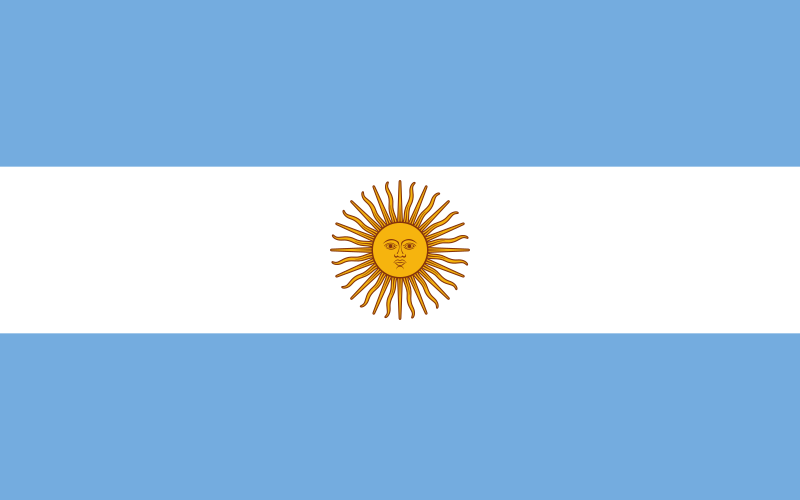
The flag is a horizontal triband of light blue, white and light blue in the proportion 5:8, with the Sun of May at the centre of the white band. Manuel Belgrano created it, and it was first raised at Rosario on 27 February 1812 during the war of independence. The present version dates from 1861, and its design was standardised in November 2010. The sun has a face and 32 rays, straight and wavy in turn.
Questions about the names and provinces of Argentina
What does the name Argentina mean?
Land of silver. It comes from Latin argentum, silver, and appears on a Venetian map of 1536.
How many provinces does Argentina have?
23 provinces plus the Autonomous City of Buenos Aires, 24 units in ISO 3166-2:AR.
What are Argentina's ISO codes?
AR (alpha-2), ARG (alpha-3) and 032 (numeric) in ISO 3166-1. Provinces carry one letter, such as AR-X for Córdoba.
Is the capital of Buenos Aires Province the city of Buenos Aires?
No. The province is governed from La Plata; the city of Buenos Aires has been a separate federal territory since 1880.
Why was Argentina called the Argentine in English?
English used the adjective as a name. Argentina is the usual form today.