Germany (Deutschland) in other languages: flag, ISO codes, 16 states
Germany is Deutschland in German, officially Bundesrepublik Deutschland (Federal Republic of Germany), coded DE, DEU and 276. Its name is listed here in 121 languages, with Berlin, Cologne, Hamburg and Munich and the 16 states with their ISO 3166-2 codes.
Official languagesGerman; Danish, Low German, Sorbian, Romani and Frisian recognised as regional or minority languages
Checked
- alpha-2
- DE
- alpha-3
- DEU
- numeric
- 276
Bundesrepublik Deutschland
- English
- GermanyFederal Republic of Germany
- Capital
- BerlinBerlin
ISO 3166-1, checked 28 October 2026
Germany in other languages: list of exonyms
| Languages | ISO 639-2 | Name | Romanised |
|---|---|---|---|
| English | eng | Germany | same as written |
| Italian, Latin, Romansh, Romanian | ita / lat / roh / ron | Germania | same as written |
| Danish, Norwegian, Swedish | dan / nor / swe | Tyskland | same as written |
| Basque, Papiamentu, Spanish | eus / pap / spa | Alemania | same as written |
| Northern Sotho, Sotho, Tswana | nso / sot / tsn | Jeremane | same as written |
| Afrikaans, Dutch | afr / nld | Duitsland | same as written |
| Bosnian, Croatian | bos / hrv | Njemačka | same as written |
| Fijian, Igbo | fij / ibo | Jamani | same as written |
| Indonesian, Malay | ind / msa | Jerman | same as written |
| Kinyarwanda, Rundi | kin / run | Ubudagi | same as written |
| Kurdish, Turkish | kur / tur | Almanya | same as written |
| Northern Ndebele, Tsonga | nde / tso | Jarimani | same as written |
| Samoan, Tuvaluan | smo / tvl | Siamani | same as written |
| Xhosa, Zulu | xho / zul | iJalimani | same as written |
| Azerbaijani | aze | Almaniya | same as written |
| Bislama | bis | Jemeni | same as written |
| Breton | bre | Alamagn | same as written |
| Catalan | cat | Alemanya | same as written |
| Czech | ces | Německo | same as written |
| Cornish | cor | Almayn | same as written |
| Corsican | cos | Alemagna | same as written |
| Welsh | cym | yr Almaen | same as written |
| German | deu | Deutschland | same as written |
| Esperanto | epo | Germanujo | same as written |
| Estonian | est | Saksamaa | same as written |
| Faroese | fao | Týskland | same as written |
| Finnish | fin | Saksa | same as written |
| French | fra | Allemagne | same as written |
| West Frisian | fry | Dútslân | same as written |
| Gilbertese | gil | Tiaman | same as written |
| Scottish Gaelic | gla | a' Ghearmailt | same as written |
| Irish | gle | an Ghearmáin | same as written |
| Galician | glg | Alemaña | same as written |
| Hawaiian | haw | Kelemania | same as written |
| Hungarian | hun | Németország | same as written |
| Icelandic | isl | Þýskaland | same as written |
| Latvian | lav | Vācija | same as written |
| Lithuanian | lit | Vokietija | same as written |
| Luxembourgish | ltz | Däitschland | same as written |
| Malagasy | mlg | Alemaina | same as written |
| Maltese | mlt | Ġermanja | same as written |
| Maori | mri | Tiamani | same as written |
| Palauan | pau | Dois | same as written |
| Polish | pol | Niemcy | same as written |
| Portuguese | por | Alemanha | same as written |
| Slovak | slk | Nemecko | same as written |
| Slovenian | slv | Nemčija | same as written |
| Sami | smi | Duiska | same as written |
| Somali | som | Jarmal | same as written |
| Albanian | sqi | Gjermani | same as written |
| Sardinian | srd | Germània | same as written |
| Swati | ssw | Jalimani | same as written |
| Swahili | swa | Udachi, Ujerumani | same as written |
| Tahitian | tah | Purutia, Heremani | same as written |
| Tagalog | tgl | Alemanya, Germanya | same as written |
| Tongan | ton | Siamane | same as written |
| Tok Pisin | tpi | Jemani | same as written |
| Turkmen | tuk | Germaniýa | same as written |
| Uzbek | uzb | Olmoniya, Germaniya | same as written |
| Venda | ven | Dzheremane | same as written |
| Vietnamese | vie | Đức | same as written |
| Bashkir, Bulgarian, Karakalpak, Komi, Kazakh, Russian | bak / bul / kaa / kom / kaz / rus | Германия | Germanija |
| Chechen, Chuvash, Ossetian | che / chv / oss | Германи | Germani |
| Belarusian | bel | Нямеччына, Германія | Njameččyna, Hermanija |
| Kabardian | kbd | Германие | Germanie |
| Kyrgyz | kir | Германия, Алмания | Germanija, Almanija |
| Macedonian | mkd | Германија | Germanija |
| Mongolian | mon | Герман | German |
| Serbian | srp | Немачка | Nemačka |
| Tajik | tgk | Олмон, Олмониё, Германия | Olmon, Olmonijo, Germanija |
| Ukrainian | ukr | Німеччина | Nimeččyna |
| Dari, Persian | dar / fas | آلمان | Ālmān |
| Arabic | ara | المانيا | Almāniyā |
| Pashto | pus | المان | Almān |
| Sindhi | snd | جرمني | Ǧarmanī |
| Uyghur | uig | گېرمانىيه | Germaniyä |
| Urdu | urd | جرمنی | Ǧarmanī |
| Dhivehi | div | ޖޭރްމަނީ | Jērmanī |
| Amharic | amh | ጀርመን | Ǧarman |
| Hebrew | heb | גרמניה | Germania |
| Yiddish | yid | דײַטשלאַנד | Daytšland |
| Greek | ell | Γερμανία | Germanía |
| Armenian | hye | Գերմանիա | Germania |
| Georgian | kat | გერმანია | Germania |
| Hindi | hin | जर्मनी | J̌armanī |
| Marathi | mar | जमिन | J̌amin |
| Nepali | nep | जमनी | J̌amanī |
| Bengali | ben | জার্মানী | J̌ārmānī |
| Gujarati | guj | જમિની | J̌aminī |
| Tamil | tam | ஜெர்மன், ஜெர்மனி | J̌ermaṉ, J̌ermaṉi |
| Chinese | zho | 德意志, 德国 | Deyizhi, Deguo |
| Japanese | jpn | ドイツ | Doitsu |
| Korean | kor | 독일 | Dogil |
| Burmese | mya | ဂျာမနီ | Jamáni |
| Thai | tha | เยอรมนี | Yermanī |
| Lao | lao | ເຢັຍລະມັນ | Yanylaman |
Chinese gives the full transcription 德意志 beside the everyday short form 德国. Kinyarwanda and Rundi share one form, as do Northern Sotho, Sotho and Tswana.
Deutschland, Allemagne, Niemcy: six roots for one country
No other European country has so many unrelated names. The table falls into six main families. Deutschland comes from Old High German diutisc, of the people, and the same root gives Dutch Duitsland, Danish and Swedish Tyskland, Icelandic Þýskaland and Yiddish דײַטשלאַנד (Daytšland). English Germany, Italian and Romanian Germania, Russian Германия and Greek Γερμανία continue the Latin name Germania.
French Allemagne, Spanish Alemania, Turkish Almanya and Persian آلمان (Ālmān) go back to the Alamanni tribe. Finnish Saksa and Estonian Saksamaa are named after the Saxons. Polish Niemcy, Czech Německo, Ukrainian Німеччина and Hungarian Németország share the Proto-Slavic *němьcь, speechless, because German could not be understood by Slavic speakers. Latvian Vācija and Lithuanian Vokietija form a sixth group whose origin is unclear.
Each family reaches well beyond Europe. Arabic المانيا (Almāniyā) belongs with the Alamanni names, Swahili Ujerumani and Samoan Siamani with the Germania names. Vietnamese Đức is the Sino-Vietnamese reading of 德, the first character of Chinese 德意志 (Deyizhi); Japanese ドイツ (Doitsu) and Korean 독일 (Dogil) take the Deutsch root.
Berlin in other languages
| Languages | ISO 639-2 | Name | Romanised |
|---|---|---|---|
| English, German, French | eng / deu / fra | Berlin | same as written |
| Catalan, Czech, Icelandic, Spanish | cat / ces / isl / spa | Berlín | same as written |
| Esperanto, Italian | epo / ita | Berlino | same as written |
| Estonian | est | Berliin | same as written |
| Finnish | fin | Berliini | same as written |
| Irish | gle | Bearlín | same as written |
| Latvian | lav | Berlīne | same as written |
| Lithuanian | lit | Berlynas | same as written |
| Dutch | nld | Berlijn | same as written |
| Portuguese | por | Berlim | same as written |
| Belarusian, Ukrainian | bel / ukr | Берлін | Berlin |
| Bulgarian, Russian | bul / rus | Берлин | Berlin |
| Arabic | ara | برلين | Barlīn |
| Urdu | urd | برلن | Barlin |
| Greek | ell | Βερολίνο | Verolíno |
| Chinese | zho | 柏林 | Bolin |
| Japanese | jpn | ベルリン | Berurin |
| Korean | kor | 베를린 | Bereullin |
| Burmese | mya | ဘာလင် | Bʰalĩ |
| Thai | tha | เบอร์ลิน |
Cologne (Köln) in other languages
| Languages | ISO 639-2 | Name | Romanised |
|---|---|---|---|
| English, French | eng / fra | Cologne | same as written |
| Italian, Spanish | ita / spa | Colonia | same as written |
| Czech | ces | Kolín nad Rýnem | same as written |
| German | deu | Köln | same as written |
| Latvian | lav | Ķelne | same as written |
| Dutch | nld | Keulen | same as written |
| Polish | pol | Kolonia | same as written |
| Portuguese | por | Colónia | same as written |
| Belarusian, Russian, Ukrainian | bel / rus / ukr | Кёльн | Kjol'n |
| Bulgarian | bul | Кьолн | K'oln |
| Arabic | ara | كولونيا | Kūlūniyā |
| Greek | ell | Κολωνία | Kolōnía |
| Chinese | zho | 科隆 | |
| Japanese | jpn | ケルン | Kerun |
| Korean | kor | 꼴로뉴 | Kollonyu |
| Thai | tha | โคโลญน์ |
Hamburg in other languages
| Languages | ISO 639-2 | Name | Romanised |
|---|---|---|---|
| English, German | eng / deu | Hamburg | same as written |
| Danish, Icelandic | dan / isl | Hamborg | same as written |
| Portuguese, Spanish | por / spa | Hamburgo | same as written |
| Czech | ces | Hamburk | same as written |
| Finnish | fin | Hampuri | same as written |
| French | fra | Hambourg | same as written |
| Italian | ita | Amburgo | same as written |
| Latvian | lav | Hamburga | same as written |
| Maltese | mlt | Ħamburg | same as written |
| Belarusian, Ukrainian | bel / ukr | Гамбург | Hamburh |
| Russian | rus | Гамбург | Gamburg |
| Arabic | ara | همبورغ, همبرغ, هامبورغ, هامبرغ | Hambūrġ, Hamburġ, Hāmbūrġ, Hāmburġ |
| Greek | ell | Αμβούργο | Amvoúrgo |
| Chinese | zho | 漢堡 | Hanbao |
| Japanese | jpn | ハンブルク, ハンブルグ | Hanburuku, Hanburugu |
| Korean | kor | 함부르크 | Hambureugeu |
| Thai | tha | ฮัมบูร์ก |
Munich (München) in other languages
| Languages | ISO 639-2 | Name | Romanised |
|---|---|---|---|
| English, French, Spanish | eng / fra / spa | Munich | same as written |
| Catalan | cat | Munic | same as written |
| Czech | ces | Mnichov | same as written |
| German | deu | München | same as written |
| Croatian | hrv | Minhen | same as written |
| Italian | ita | Monaco (di Baviera) | same as written |
| Latvian | lav | Minhene | same as written |
| Polish | pol | Monachium | same as written |
| Portuguese | por | Munique | same as written |
| Romansh | roh | Minca | same as written |
| Belarusian, Bulgarian, Russian, Ukrainian | bel / bul / rus / ukr | Мюнхен | Mjunẖen |
| Arabic | ara | ميونخ, ميونيخ | Miyūniḫ, Miyūnīḫ |
| Greek | ell | Μόναχο | Mónacho |
| Chinese | zho | 慕尼黑 | Munihei |
| Japanese | jpn | ミュンヘン | Myunhen |
| Korean | kor | 뮌헨 | Mwinhen |
| Thai | tha | มิวนิค |
The 16 states (Länder) of Germany
Germany is a federation of 16 states, called Länder in German. Three of them are cities: Berlin, Hamburg and Bremen. The ISO list gives each state a two-letter code after DE and prints the names in German only; the English forms in the table are for reference.
| ISO 3166-2 | German | English | Administrative centre | Change |
|---|---|---|---|---|
| States Länder16 | ||||
| DE-BW | Baden-Württemberg | Baden-Württemberg | StuttgartStuttgart | |
| DE-BY | Bayern | Bavaria | MünchenMunich | |
| DE-BE | Berlin | Berlin | BerlinBerlin | |
| DE-BB | Brandenburg | Brandenburg | PotsdamPotsdam | |
| DE-HB | Bremen | Bremen | BremenBremen | |
| DE-HH | Hamburg | Hamburg | HamburgHamburg | |
| DE-HE | Hessen | Hesse | WiesbadenWiesbaden | |
| DE-MV | Mecklenburg-Vorpommern | Mecklenburg-Western Pomerania | SchwerinSchwerin | |
| DE-NI | Niedersachsen | Lower Saxony | HannoverHanover | |
| DE-NW | Nordrhein-Westfalen | North Rhine-Westphalia | DüsseldorfDüsseldorf | |
| DE-RP | Rheinland-Pfalz | Rhineland-Palatinate | MainzMainz | |
| DE-SL | Saarland | Saarland | SaarbrückenSaarbrücken | |
| DE-SN | Sachsen | Saxony | DresdenDresden | |
| DE-ST | Sachsen-Anhalt | Saxony-Anhalt | MagdeburgMagdeburg | |
| DE-SH | Schleswig-Holstein | Schleswig-Holstein | KielKiel | |
| DE-TH | Thüringen | Thuringia | ErfurtErfurt | |
Codes and German names: ISO 3166-2:DE on the ISO Online Browsing Platform, read from the Wikipedia table that reproduces it, checked 28 October 2026. English names follow the same table, which marks them as reference only. Capitals as listed by the state governments and in the source table.
Free states, Hanseatic cities and the flag of Germany
Several states carry a formal title in their full name. Bavaria, Saxony and Thuringia call themselves free states: Freistaat Bayern, Freistaat Sachsen, Freistaat Thüringen. The two northern city states keep their Hanseatic past, Freie Hansestadt Bremen and Freie und Hansestadt Hamburg. The ISO list drops these titles and gives the short names.
Berlin is the capital and the constitutional seat of government. Bonn, the former provisional capital of the Federal Republic, holds the title of federal city (Bundesstadt) and remains the main seat of several federal ministries.
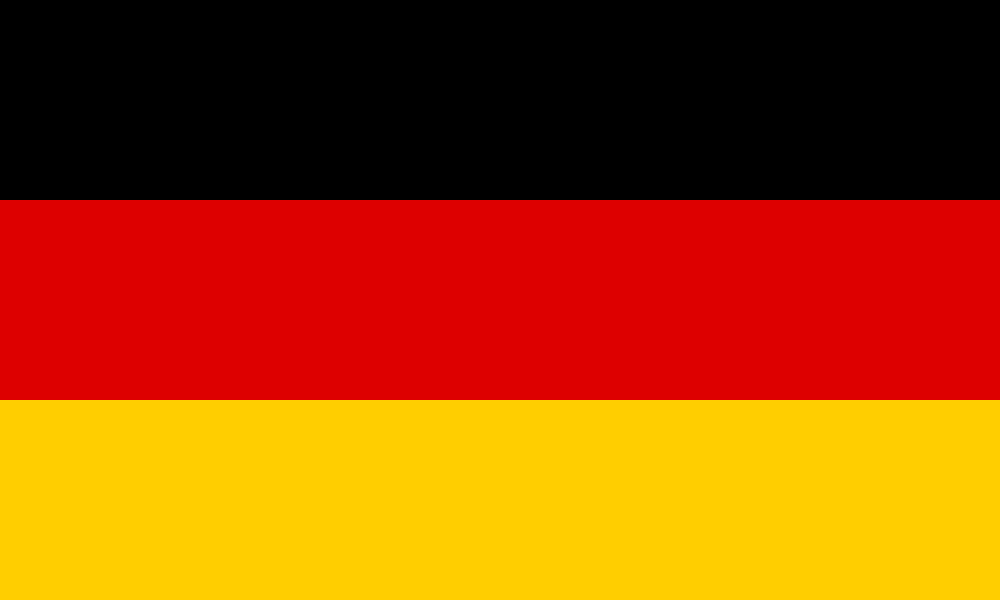
German is the official language. Danish, Low German, Sorbian, Romani and Frisian are protected under the European Charter for Regional or Minority Languages,. The flag shows three horizontal bands of equal height, black, red and gold, in the proportion 3:5.
Questions about Germany's names and states
What is the official name of Germany?
Bundesrepublik Deutschland, Federal Republic of Germany in English. The short form is Deutschland.
Why is Germany called Allemagne, Saksa and Niemcy?
Each language named the Germans after the group it met first or after an old description: the Alamanni for French, the Saxons for Finnish, and Proto-Slavic *němьcь, speechless, for Polish and the other Slavic languages.
What are the ISO codes of Germany?
DE (alpha-2), DEU (alpha-3) and 276 (numeric). The states run from DE-BW for Baden-Württemberg to DE-TH for Thüringen.
What is Munich called in Italian?
Monaco, in full Monaco di Baviera. Polish writes Monachium and Croatian Minhen.
How many states does Germany have?
Sixteen. Berlin, Hamburg and Bremen are city states; the other thirteen are territorial states.